This past winter I was the guest of
Brown-Forman Spirits on a visit to the
Canadian Mist Distillery on the Georgian Bay in Ontario. My travel companions for this visit to the Great White (and cold) North, a small group of drinks journalists, included John Hansell, Lew Bryson, Terry Sullivan and Bill Dowd.
We had an enjoyable session with Master Distiller
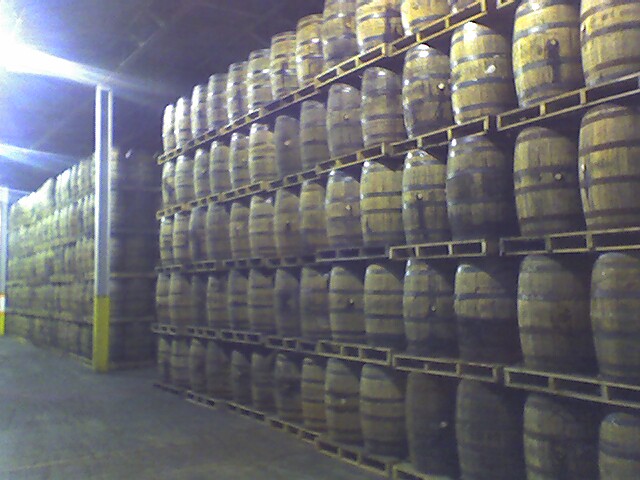
Harold Ferguson -- I found out just how difficult it truly is to make a well-balanced Canadian whisky -- but the Kid in the Candy Store moment happened when we were taken into a warehouse holding 180,000 barrels of aging whisky. To those of us who ponder the liquid we drink, a barrel is much more than a temporary bulk container. It is very much like the womb from which distilled spirits, wines and even some beers are born.
If you doubt that a barrel has a maternal influence, remember that when Bourbon goes into the barrel it is a clear liquid that can best be described as white lightning. What emerges years later has color, character and charisma; molded by the level of char in the barrel and the natural influences of the oak into a drink that millions worldwide savor.
By law, Bourbon and Tennessee whiskey can only be made in new oak barrels that have been charred to give the wood the qualities that impart all of the color and much of the flavor to whiskey. Once brands like
Rebel Yell,
Booker's or
Blanton's have been drained from the barrel, it is no longer of use to the Bourbon maker. Bonded warehouses in Kentucky hold between 3-4 million barrels of whiskey at any one point. That will keep us all in mint juleps for years to come and supply a steady stream of barrels to the world market.
Coopers make the barrels from American oak and handle the critical charring process. It takes only about one minute, but it creates the "red layer" which distillers say is the magical ingredient of the aging process Bourbon. The red layer is between the outer black part of the char and the wood, where an almost caramel-like substance holds the key flavoring agents.
Barrels from Kentucky go elsewhere in the U.S. for use in other products, such as brandy, or onto Scotland, Canada, Japan and India for whiskey, the Caribbean and South America for rum, Spain for sherry and Mexico for Tequila. A small number of
Heaven Hill barrels end up in the hands of nearby
Blue Grass Brewing for use in making Bourbon Stout, while home wine makers have also been known to buy used barrels for making corn cob and dandelion wines.
In the case of the warehouse I was visiting in Canada, the origin and destination of the barrels was a little more predetermined than most. Brown-Forman owns Bluegrass Cooperage, which makes about 350,000 barrels a year for brands like
Old Forrester,
Woodford Reserve and
Jack Daniel's. According to
Chris Morris, master distiller at Brown-Forman, after they are used once many of them head north for a stay of 9-12 years in Canada or they are dispatched to distilleries in the British Isles and elsewhere. The fact is that barrel management is an art and a science that costs drinks businesses millions of dollars annually and keeps distillers on their toes.
Depending on how it is being used, the next company may use the barrel several times before either disposing of the barrel (the thought of one of these fine casks spending its retirement years as a flower planter saddens me) or reselling them to the next user. With each use the color and flavor imparted will become a little more subtle and take on influences from what was previously in the barrel. That variation is exactly what the master blender is looking for as he puts together a blended Canadian or Scotch whisky.
Barrels not only travel extensively, but they tend to live fairly full lives. According to
Greg Leonard, public relations director for American whiskeys with
Diageo, an average lifespan for a barrel is somewhere between 40-60 years, depending on how many cycles (filling and emptying) the barrel undergoes. Diageo has approximately 10 million barrels in its inventory worldwide. After originally holding a Bourbon, some of the barrels might play host to a Tequila for a couple of years, while others that are used to hold whiskies that go into the blend that makes up Johnnie Walker Blue might house a Scotch for 60 years.
Diageo buys most of its new barrels in the U.S. from Independent Stave Co., whose coopers make American white oak barrels in Missouri and Kentucky for a number of distilleries. Oak became popular with both distillers and vintners because of the subtle characteristics it imparts to the liquid aging inside of the barrel. Oak trees that are used for the barrels might be 80 years old before they are harvested; domestically they mainly come from the Ozarks. The flavor notes from the oak range from vanilla to almond and butter to what can only be described as oakiness. American oak barrels typically cost around $100 new, while French oak barrels, which traditionally imparted more subtle flavors to wine, run around $300 each.
Getting just the right barrels is not just a critical part of the distilling process, it is now an increasingly important part of the marketing of distilled spirits, particularly Scotch. Some estimates are that about 80 percent of the barrels holding Scotch whisky once held American whiskey. The other barrels come from various sources, with the other traditional major source of cooperage coming from sherry producers. The new wave of "wood finished" Scotch means that you can find barrels in aging rooms that once held Port, Madeira, merlot, sauternes, Bordeaux and I've even read about some that were previously used for Tabasco hot sauce. Wood finishing means that after spending most of the maturation process in a traditional barrel, the spirit is moved for the final year or so to the finishing barrel. The change in flavor can be quite fantastic.
Glenmorangie has probably the widest selection of wood-finished products on the market, but they far from being alone. It is attractive to Scotch makers because they can release new line extensions and flanker brands very quickly in a world that usually requires a 10 plus year wait before something "new" is ready to bottle. Other distillers are joining the wood craze. One of the more interesting approaches comes from
Buffalo Trace Distillery, which says it has about 1,500 experimental barrels of whiskey aging at the moment. These whiskeys are all being shipped in 375 milliliter bottles and will retail for around $46.
While natural corks are still found in many wines, it is increasingly likely that you find a composite or plastic cork or even a screw cap being used to seal a quality brand. The oak barrel, however, is likely to remain an important part of the manufacture of quality spirits for decades -- hopefully centuries. For that we should all raise a glass to Mother Nature.